A review of Masks: A New Generation (1st edition)
This is my submission to the Knowledge Knight Review Jam which you can find on the Quinns Quest Discord Community, accessible by joining the Quinns Quest Patreon
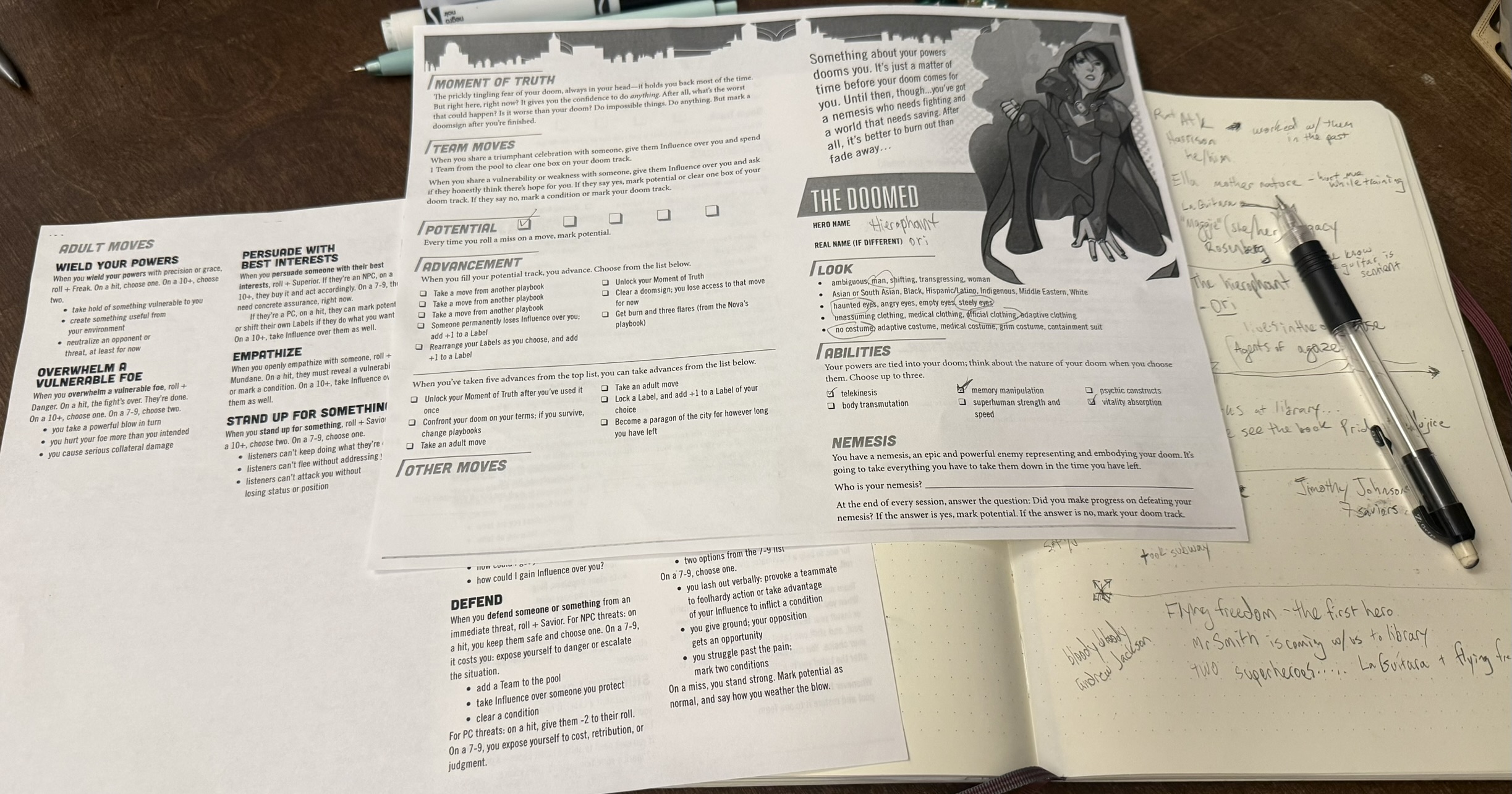
Tonight, I played a one-shot of Masks: A New Generation. I want to lead with a caveat which might preclude you from taking this review seriously: I haven’t read the full book. I’ve just been taught how to play and been led through character generation with the other players. The experience was incredibly fulfilling, and if you enjoy character drama, blasting villains, pranking your teacher, or navigating a teen crush, then you should play this game.
There are a few core pillars to Masks. You play teenage superheroes who have competing identities: being a teenager and being a superhero. You select a playbook that represents many typical superheroes from pop culture. Maybe you have super speed, or can manipulate matter, or fly. You go on adventures. What kinds? Well, ours took place on a school field trip.
Character creation instantly helped kickstart what kinds of scenes I could imagine playing out. Whether it was a scene about being a goofy teenager or being a superhero. My character was “The Doomed”, someone who had a terrible fate and could take actions to speed up that fate and gain abilities. The whole playbook provided so much fuel for me to riff on.
I didn’t skip a beat when the GM called for us all to introduce our characters on their way to school in the morning: “They’re ditching their adult supervision and using telekinesis to steal a hot dog from a vendor on the way to school. Then the camera zooms out, and you see them laying on top of a moving subway car listening to music.” All of this from reading telekinesis on the ability list and thinking that this character was from some sort of old government agency that dealt with the occult.
The playbooks go on to provide more mechanics to help push scenes forward. The Doomed is asked two questions. “You told _______________ all about your doom and the danger you’re in” and “You’d love to kiss ________________ before your doom comes.” There’s so much to do with this. Ok yes, this teen has a crush. And in telling another character all about my doom, they probably were just thinking of the crush.
These two short questions helped build up scenes, along with the other players’ scenes, that filled the three and a half hour session. I quickly knew more about this character than I have for 90% of Dungeons and Dragons’ characters I’ve tried to roleplay. We were students going to school, which is very relatable for most people. These students were going on a field trip to research something at a library. Again, relatable. A villain attacks the library, summoning people from a book to achieve their goals. Probably seen this in a movie or cartoon. And of course, I’m roleplaying a teenager with a crush. Incredibly relatable. Throughout all of this, the superhero abilities we used would ultimately affect the teenagers we were playing on a personal level. And it was so simple to accomplish.
The adventure started with the game master having us go on a field trip to the library. One of the exhibits was packed, and without prompting, we decided to try and sneak our way in. Let me run down how using moves works so we can dig into how they affect the characters and the adventure in play. During our session, the players would simply state what we did and trigger moves:
I told the table and GM: “I want to use telekinesis to make that skateboard roll through the crowd and cause a distraction to help a couple of us get into the packed library exhibit quicker.”
Another player might add, “Oh, what if my intelligent rat friend was riding it?”
The GM: “Ok roll to Unleash your Powers.” This meant rolling 2d6 and reviewing the move to figure out the outcome. Here’s the move in full:

With the skateboarding incident, I rolled a 7-9. I was successful in the attempt, but the skateboard went way faster than I intended, and we collectively decided that I would mark the condition “Guilty”. Conditions are a fictional mechanic that can affect how you roleplay your character but also have an impact on the dice rolls you might make.
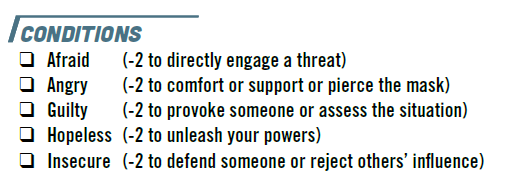
So now anytime I provoked someone or assessed a situation, I would have a -2 apply to the roll, which with a 2d6 system could be a big deal. Was it fun to use the playbook’s doom mechanic to get more and more exhausted, piling on negative conditions but inching ever closer to getting cool new abilities? Yes. It was also exciting to turn the villain's attack onto the artifact they were using to control a papier-mache Jane Austen character with an axe.
But it was the moments after these encounters where the teenagers had to reckon with what happened that stood out the most. Exchanges of kind words or awkward hugs when words couldn’t be found.
We started to discover this interaction about halfway through the session; most of us had two to four conditions marked. The GM suggested we try the Comfort or Support move. To do the move, you narrate the fiction and tell the table how the characters provide comfort or support. Then you must roll to see what happens. Here is the rule in full:

On a hit means you need to roll a 7 or higher to get the first effect. Otherwise, you can’t help them in that moment.
After roleplaying some kind words to my character’s crush, I rolled too low to provide enough comfort to remove a condition. Halfway through trying to comfort their crush they were shut up with a hug. The embarrassment was easy to play out at the table. This was all after his crush, who had twirled in the air, went through a tropey magical girl transformation, and defeated a vampire that came out of a book. Pure pulpy magic.
I want to also note that we could have removed these conditions from ourselves at a fictional cost, for instance to clear guilt, I would have needed to make a sacrifice to absolve my character’s guilt. It's yet another mechanic that really drives home how you’re supposed to use the moves to engage and change the fiction of the teenage superhero you’re playing.
Let’s move to some of the more superhero moments. We were frequently trading blows with villains or minions, and “Take a Powerful Blow” supports that fiction:
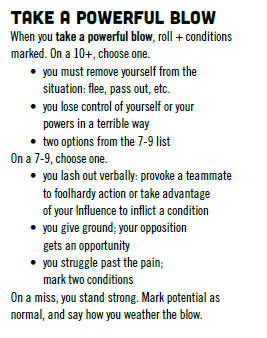
Near the end of the session, I rolled a 10+ on this move. I had just used the playbook’s vitality absorption skill to render the main villain inert, but my character also lost control. We may have triumphed over the villain, but my character, The Doomed, was stunned and crying over the body. Their crush knelt and hugged them, triggering Comfort or Support. They rolled a high result, and the GM suggested that the PC could remind The Doomed why they were human, which would help them regain their sense of self. The scene was a bittersweet moment as my Doomed dealt with the pain of their powers and the connection with their friends.
Again and again, each mechanic we touched on during the session felt like it boosted the scene it was used in. As we wrapped up the session, I felt like I knew who the Doomed was. I understood a bit more about them as a teenager and their superhero persona.
I’ve been playing a lot of new roleplaying games lately. I've enjoyed them, but I am starting to see that some games push you forward in the fiction and, through mechanics, they help you roleplay your character and develop them into more than just the sheet on the table. Most of the time, these games also have mechanics that are just easy to use. The moves in Masks aren’t complicated. We didn’t have to engage with many of them to get poignant or exciting moments, whether it was hugging a friend or ripping an evil artifact out of a villain's hands to destroy it. But each time it felt like the mechanics were there to support the fiction and all the players.
This was also my first time playing a Powered by the Apocalypse game; it felt like a completely different experience compared to many other TTRPGs. No longer was I just rollplaying; I was roleplaying. I still love those other games; a dungeon crawl is fun, D&D is fun, there’s time for beer-and-pretzels gaming, but when a playbook helps you roleplay? The juice you can squeeze from that sheet of paper is incredible.
I’m normally the game master for the groups I play with. The scenario our GM created was special. It made it easy to sit with a character, a teenage superhero, who was doomed but had something or someone else to focus on and go on a dorky adventure in a library to research a paper, something I haven’t done in years. It almost felt like I was a kid playing make-believe once again.
I hope to play more of Masks. They even have a new Kickstarter coming soon with a quickstart. And while I want to run that, I might start with a simple field trip that goes wrong and requires a bit of super help.